
Anyone looking to replace a faulty LED driver will almost always come across two terms: constant current and constant voltage.
This distinction is crucial – because using the wrong driver can result in the LED failing to work, flickering or even becoming damaged.
In this guide, we explain what matters in a simple and practical way.
Why are there different types of LED drivers?
LEDs require a specific electrical supply. Depending on the design of the luminaire, this is provided either by:
- a constant-current driver (CC)
or - a constant-voltage driver (CV)
Which type is required depends on the LED technology used.
What is a Constant-Current LED Driver?
A constant-current driver supplies a fixed output current.
The voltage automatically adjusts within a specific range.
Typical output currents include, for example:
- 350 mA
- 500 mA
- 700 mA
- 1050 mA
The voltage is often specified as a range, for example:
- 18–42 V DC
Typical Applications
Constant-current drivers are frequently used in:
- high-quality LED luminaires
- recessed luminaires
- pendant luminaires
- LED modules
- professional lighting systems
What is a Constant-Voltage LED Driver?
A constant-voltage driver supplies a fixed voltage.
The current is determined by the connected LED or electronics.
Typical voltages are:
- 12 V DC
- 24 V DC
Typical Applications
Constant-voltage drivers are often found in:
- LED strips
- furniture lighting
- kitchen lighting
- decorative lighting
- many low-voltage systems
CC/CV LED Drivers (Universal Drivers)
In addition to pure constant-current or constant-voltage drivers, there are also so-called CC/CV LED drivers (Constant Current / Constant Voltage).
Depending on the application, these models can operate either as a constant-current or constant-voltage source.
What does this mean in practice?
CC/CV drivers adapt flexibly to the connected LED application within certain technical limits.
This can be particularly helpful when:
- the exact driver type cannot be clearly identified,
- various LED systems are to be powered,
- or a certain degree of technical flexibility is required for a replacement solution.
Important to Note
Even with CC/CV drivers, fixed electrical limits apply.
This means:
- current and voltage ranges must still be suitable for the application,
- there is no such thing as complete ‘universal compatibility’.
How Do I Know Which Driver I Need?
The simplest way:
Check the specifications on the old driver.
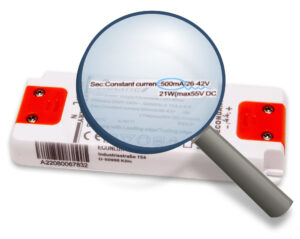
Indications of Constant Current (CC)
CC drivers are labelled ‘CC’ or ‘Constant Current’, and the output current is specified as a fixed value:
- „350 mA“
- „700 mA“
- „Constant Current“
- Voltage specified as a range
Example:
Output: 500 mA, 24–42 V DC
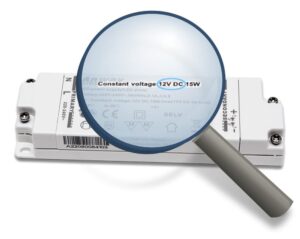
Indications of constant voltage (CV)
CV drivers are labelled ‘CV’ or ‘Constant Voltage’ and the output voltage is specified as a fixed value:
- „12 V DC“
- „24 V DC“
- „Constant Voltage“
Example:
Output: 12 V DC
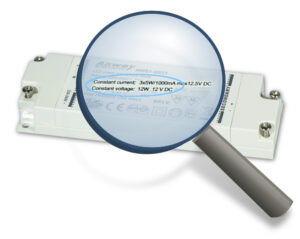
Indications of a universal driver (CC/CV)
Universal drivers are labelled with both specifications:
- “Constant Current [Data]”
“Constant Voltage [Data]”
Example:
Constant Current: 1000 mA, Constant Voltage 12 V DC
Why Voltage Alone is Not Sufficient
A common mistake:
Attention is paid only to the voltage.
However, with constant-current drivers in particular, the output current is crucial.
An incorrect current value can damage LEDs or lead to malfunctions.
Can constant-current and constant-voltage drivers be interchanged?
As a general rule: no!
A constant-current driver should only be replaced with a suitable constant-current driver!
The same applies to constant-voltage systems.
Which specifications must match when replacing a driver?
The following are particularly important:
- Output current or output voltage
- Power range (watts)
- Dimming function
- Design and connections
The replacement model does not always have to be identical – the electrical specifications are what matter.
Finding Replacements for LED Drivers that Are No Longer Available
Many original LED drivers are no longer available after a few years.
However, it is often possible to find a technically suitable replacement.
Using the driver search function on
anway-led-treiber.de
you can search either by model number (if the failed driver was an ANWAY model) or by electrical specifications (for all other models).
Conclusion
When looking for a suitable replacement driver, the most important factor is whether the existing LED is operated at constant current or constant voltage. Clarifying this is the first step.
Once this has been clarified, the key output values can often be used to find a suitable replacement, even for older models or those no longer available.
Work on electrical equipment and mains voltages should only ever be carried out by qualified personnel.
Always disconnect the power supply completely before replacing an LED driver. If in any doubt, we recommend consulting a qualified electrician.


